

Sustainability
- TOP_EN
- Sustainability
- Initiatives in response to TCFD recommendations
Initiatives in response to TCFD recommendations
Governance
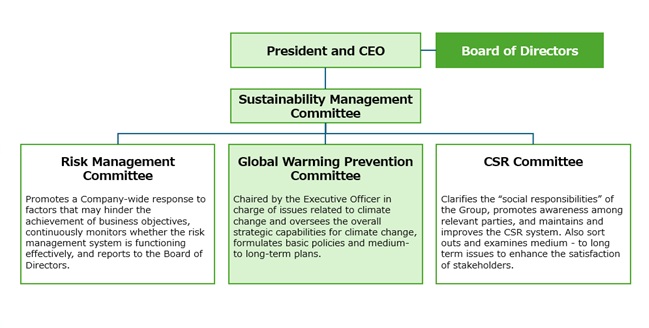
Regarding the response to risks and opportunities related to climate change, the “Global Warming Countermeasures Committee,” chaired by the President and Representative Director, is responsible for formulating basic policies, developing medium- to long-term plans, and examining information disclosure based on the TCFD. The President and Representative Director also reports to the Board of Directors as necessary. The Global Warming Countermeasures Committee is chaired by the Executive Officer responsible for climate change-related issues and is composed of the heads of the Production Management, Corporate Planning, Environmental Management, Technical Management, and General Affairs departments. The committee oversees the company’s overall strategy for addressing climate change and deliberates on matters such as setting greenhouse gas (GHG) emissions reduction targets and introducing renewable energy. The outcomes of the committee’s discussions are reported to the Sustainability Management Committee, a higher-level committee, which in turn reports them to the Board of Directors.
■Climate change-related governance structure
Strategy
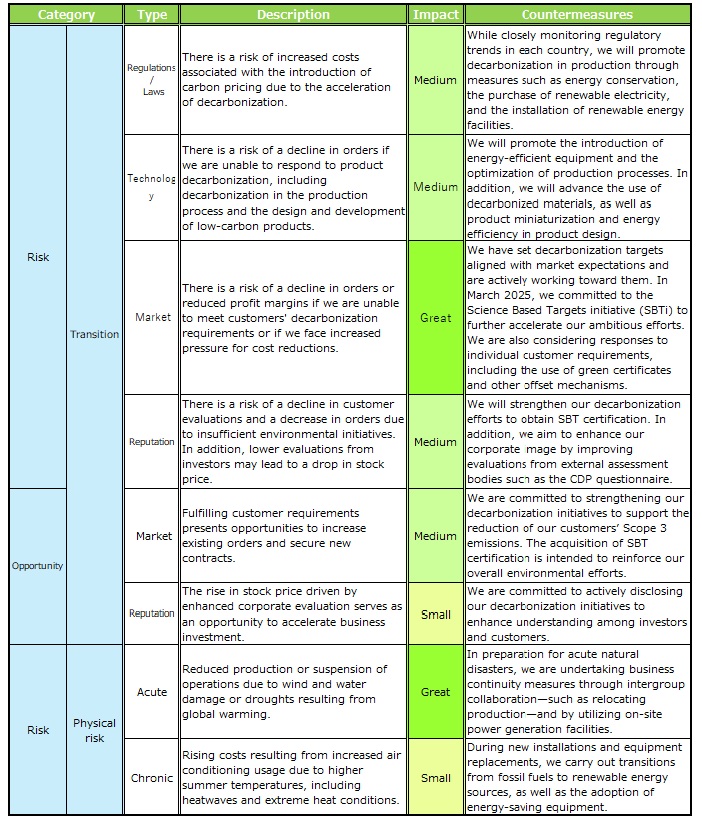
Hosiden believe that climate change countermeasures have a significant impact on corporate business activities, and that it is important to analyze the extent of this impact and develop appropriate strategies.We conducted an analysis of the risks and opportunities in transitioning to a world below 1.5/2°C, and the physical risks in a world above 4°C (as is) to identify the risks and opportunities associated with climate change.
※The scenarios used in the analysis were the 1.5/2°C and 4°C scenarios from the IPCC and IEA.
(IPCC-SSP1-2.6、IPCC-SSP5-8.5、IEA-WEO)
IPCC(Intergovernmental Panel on Climate Change): Intergovernmental Panel on Climate Change
IEA(International Energy Agency) : International Energy Agency
In our analysis, we focused on transition risks and opportunities by considering the likelihood of a rapid increase in market demands and responses aimed at catching up with delayed decarbonization efforts. We analyzed various aspects such as regulations, technological developments, market trends, and stakeholder reputation. Regarding physical risks, we identified both acute and chronic risks associated with global warming and analyzed potential responses to those risks.
Risk Management
In our risk management, we define risk as factors that may hinder Hosiden and its affiliates from achieving their business objectives. Our basic policy for risk management is to prevent any significant adverse impact on our customers, business partners, employees, surrounding areas, and other stakeholders related to the Group when risks materialize.We identify, assess, and manage climate change-related risks with the Global Warming Prevention Committee and the Risk Management Committee. Identified risks are appropriately classified and evaluated based on their impact on the business and frequency of occurrence, and countermeasures are considered and implemented according to the magnitude of materiality. The Risk Management Committee continuously monitors the effectiveness of the risk management system and reports to the Board of Directors
Indicators and Targets
Hosiden regards global warming as a major problem that affects the survival of the Company and believes it is necessary to engage in a Group-wide effort to prevent global warming. Therefore, we are committed to identifying Group-wide CO2 emission volumes and setting reduction targets for reducing greenhouse gas emissions. Specifically, we are working to reduce the use of fossil fuels, including heavy oil and gas, by adopting state-of-the-art energy-efficient equipment during both facility upgrades and new installations. Following the installations in Hosiden Wakayama, Hosiden Kyushu, and Hosiden Besson(U.K) solar power generation facilities have also been operational since the previous fiscal year at the Tokyo Plant (September 2024) and the Head Office (November 2024). In Hosiden Vietnam, the installation is also scheduled to become operational in fiscal year 2026. As of this fiscal year, we have transitioned the purchased electricity of our domestic group companies (excluding certain sales offices) to 100% renewable energy, resulting in a significant reduction in CO₂ emissions. To advance our ambitious initiatives, Hosiden obtained SBT certification in August 2025 (publicly announced in September). In response, we have newly established medium- to long-term reduction targets for Scope 1, 2, and 3 emissions, aligned with SBT standards, to further accelerate our decarbonization efforts. Hosiden will continue to contribute to the realization of a sustainable society and the attainment of carbon neutrality.
■CO₂ Emissions Reduction Targets
(Scope 1, 2, and 3)
- ●Medium-term target
・46% reduction in total CO2 emissions from FY2023 levels by the end of FY2030 (Scope 1 and 2)
-
・Scope 1 and 2 GHG emissions 42% by FY2030 from a FY2023 base year. (SBT certification goals)
-
・Scope 3 GHG emissions 25% by FY2030 from a FY2023 base year. (SBT certification goals)
- ●Long-term target
- ・Aim to achieve carbon neutrality by FY2050.